

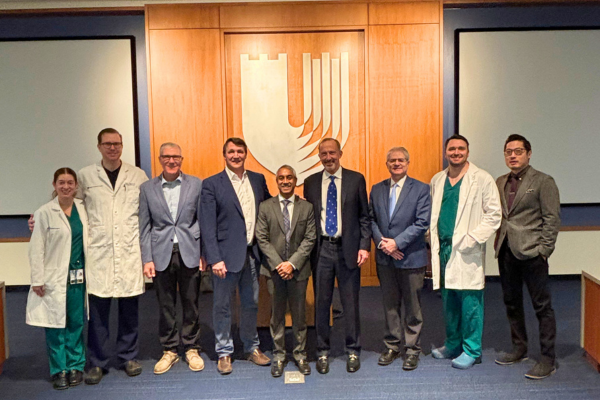
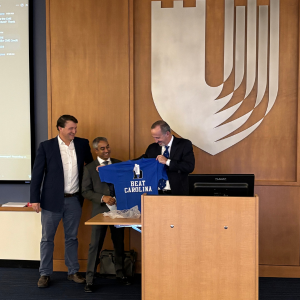
The Duke Hand Society hosted Dr. Robin Kamal, MD, MBA, Co-Director of the Robert A. Chase Hand and Upper Limb Center at Stanford University and Associate Professor of Orthopaedic Surgery, as the 36th Annual Visiting Professor during Duke Orthopaedics Grand Rounds on February 4. Kamal delivered a forward-looking lecture titled “Outside of the Operating Room: How Orthopaedic Practice is Evolving.”
“Duke is an incredibly special place to be,” Kamal remarked as he opened his talk, setting the stage for a discussion focused on how musculoskeletal (MSK) surgeons can better deliver care both inside and outside the operating room.
Redefining Orthopaedic Care Before and After Surgery
Kamal emphasized the importance of expanding the surgeon’s role beyond technical expertise in the OR.
“How do we deliver healthcare as MSK surgeons? What’s the science we can implement before the patient needs to see us for treatment?” he asked.
While orthopaedic practices have embraced rapid technical innovation, he noted the growing need to take greater ownership of the patient journey—including prevention, care coordination, and long-term recovery. Patients increasingly recognize the value of comprehensive, holistic care, creating opportunities to collaborate with insurance partners to deliver services that may reduce the need for surgery.
Growth of Shared‑Risk and Managed Care Models
He described the accelerating adoption of managed care frameworks, such as Medicare Advantage, which operate on shared‑risk principles. These models continue to expand nationally; at Stanford, more than 43% of patients are enrolled in Medicare, reflecting broader market trends.
He highlighted Duke’s leadership in developing longitudinal care bundles, noting their potential to set national standards. He also underscored the value of ongoing collaboration between Duke and Stanford faculty, including joint work with Malcolm DeBaun, MD, on the Surgical Wait Times and Outcomes for Fracture Treatment (SWIFT) program.
Citing Frank Sonnenberg’s well-known principle—“If everything is a priority, then nothing is a priority”—Kamal described how clear prioritization improves outcomes. At present, only 20% of hip fracture patients receive surgery within 48 hours. Initiatives such as the Surgical Wait Times and Outcomes for Fracture Treatment (SWIFT) program aim to improve outcomes through intentional, multidisciplinary coordination among PT and OT teams. SWIFT's primary aim is to improve patient recovery after fractures and decrease related morbidity and mortality.
The ultimate goal: moving from fracture care to accountable care.
Being Responsible Stewards of Patient Resources
Kamal also encouraged providers to be mindful stewards of resources, noting that patients weigh not only clinical decisions but also direct, indirect, and intangible costs, such as time and the burden on daily life.
“Patients are focused on far more than the procedure itself,” he said. “We need to consider the full picture.”
Learning From Global Experience
He closed with a question: Can U.S. orthopaedic practices learn from managed‑care innovations used around the world? His answer: an unequivocal yes. Integrating global best practices, he said, will be essential as orthopaedic care continues to evolve in scope, responsibility, and delivery.