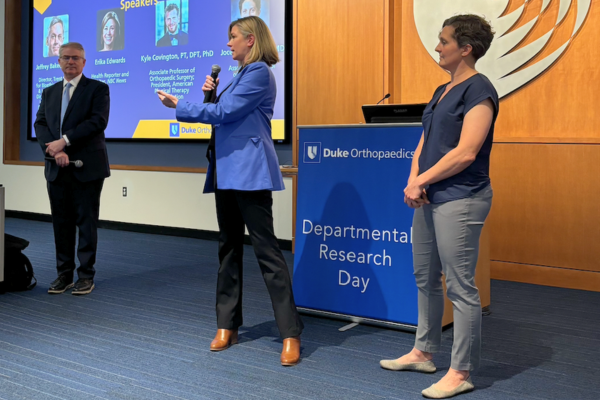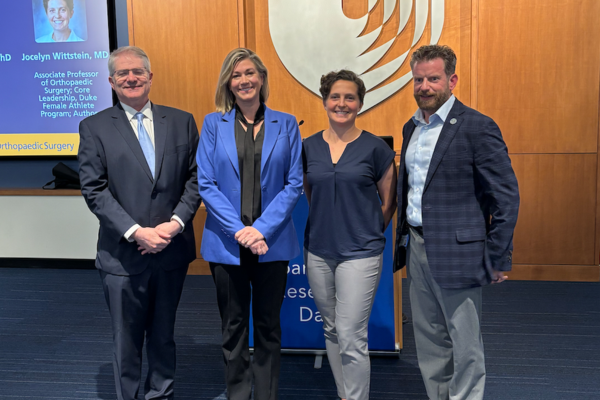
The 2026 Departmental Research Day & Symposium convened a multidisciplinary audience of clinicians, scientists, trainees, and communicators around a timely panel titled “Aligning Science & Society.”
The symposium explored a pressing question facing healthcare and research today: How do we build public trust in science—and ensure research meaningfully reaches the communities it is meant to serve? Through perspectives spanning history, journalism, advocacy, and social media, panelists challenged the audience to think beyond the lab and consider how science is communicated, understood, and acted upon.
A Framing Question: Why Don’t People Trust Science?
Department Chair Benjamin Alman, MD, opened the panel by framing the discussion around a central concern.
“Why don’t people trust science? What can we do to help people understand science?” he asked.
Alman noted that trust in science and scientists has weakened in recent years, driven in part by the rise of social media as a primary news source and the widespread reach of misinformation. The appeal of oversimplified narratives, he said, often replaces the nuanced reality of scientific discovery. “News and information shouldn’t require a scavenger hunt,” he added, underscoring the responsibility researchers share in making science accessible and understandable.
History, Context, and Trust
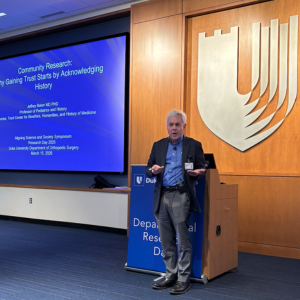
Jeffrey Baker, MD, PhD, Director of Duke’s Trent Center for Bioethics, Humanities & History of Medicine, began the discussion by grounding the issue of trust in a historical context.
“Trust in clinical information often starts with knowledge of local history,” he said.
Baker emphasized that communities bring lived experiences and historical memory to their interactions with healthcare systems. To better meet people where they are, he partnered with Duke colleague Damon Tweedy, MD, to launch the UNHEALED podcast, which examines the historical roots of health inequities and mistrust. The project initiated by the Trent Center for Bioethics, Humanities & History of Medicine at Duke University School of Medicine, in collaboration with the Duke University Institutional History Project.
“I can only answer common clinical science questions by helping the public understand that research saves lives,” he said. “Research is hard, and it doesn’t happen overnight.”
Using Durham and Duke University’s own origin stories as examples, Baker illustrated how multiple versions of history exist—and why telling those stories clearly and honestly matters. “History is important,” he said. “There are a lot of versions of stories. We need to be able to tell these stories well.”
From the Lab to the Living Room
Erika Edwards, NBC News Health Reporter and Writer, offered insight into how medical research reaches the public through journalism.
“I love my job because I learn something new every day,” she said. “My goal is to reach the audience in a meaningful way.”
Edwards highlighted that approximately 76 percent of individuals ages 16–19 get their news from social media, shaping how journalists must frame and present stories. She encouraged researchers to consider audience characteristics and attention spans—what will keep someone with a story long enough to understand it?
She also shared practical guidance for engaging with media, outlining the “NBCs” of interviews:
- Always assume interviews are on the record
- Understand what may be in the background
- Clarify what is off the record
- Know that both reporters and sources have rights
“At NBC, ethics in journalism exists,” Edwards said, noting that editors and lawyers review stories. “As a health reporter, telling stories about medicine pushes me to understand the nuances of medical research. I want audiences to find relatable, honest information that helps them live well.”
Advocacy as a Professional Responsibility
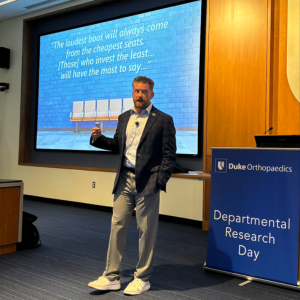
Kyle Covington, PT, DPT, PhD, Associate Professor of Orthopaedic Surgery and President of the American Physical Therapy Association, delivered a call to action focused on advocacy.
“The research we are doing in orthopaedics, physical therapy, and occupational therapy is vital,” he said. “But we have to continually deliver this message to our state and federal lawmakers.”
Covington emphasized that many policymakers do not fully understand the scope or value of rehabilitation care and research. Advocacy, he said, is about keeping healthcare accessible and balanced—and it works best as a team sport. He highlighted partnerships with organizations such as the AAOS and AOTA and stressed the importance of grassroots engagement.
“Our stories matter more than statistics,” he said, noting that meaningful change often takes decades. Current priorities include Medicare reform, applying annual inflation adjustments, and recognizing PT, OT, and nursing education programs as medical programs to better support students through federal loan options.
Meeting Patients Where They Are—Online
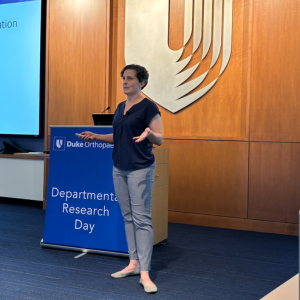
Closing the panel, Jocelyn R. Wittstein, MD, Associate Professor of Orthopaedic Surgery, Core Leader of the Duke Female Athlete Program, and author, shared how social media has transformed her approach to research dissemination.
“If more than 68 percent of people ages 30–40 are getting their health news from social media, we need to meet them where they are,” she said.
Wittstein described how her research on women’s bone health led her to co-author a book—and later, to embrace social media as a tool for health literacy. In early 2025, she began posting short, unscripted Instagram reels sharing bone health facts and practical tips. Within a year, her account (@jocelyn_wittstein_md) grew to more than 100,000 followers, with some videos reaching 1–3 million views.
“The formula is sharing information and giving an action item,” she said. “Providing lay summaries of research is tremendously helpful—and appreciated—by wider audiences.”
A Shared Responsibility
The 2026 Research Day Symposium underscored a shared message across disciplines: advancing science is not enough. Building trust, engaging communities, advocating for patients, and communicating clearly are professional responsibilities for all healthcare providers.
As the panel demonstrated, aligning science and society requires history, humility, and a willingness to step beyond traditional academic boundaries—into newsrooms, legislative offices, podcasts, and social media feeds—to ensure research truly serves the public good.