

Duke Orthopaedic Surgery made a significant national impact at the AO Trauma North America Blended Course – Advanced Principles of Fracture Management, held February 12–14, 2026, in Kansas City, Missouri. Dr. Malcolm DeBaun, MD, section chief of Orthopaedic Trauma and associate professor of Orthopaedic Surgery, served as faculty for the course, contributing to case discussions, didactics, and surgical skills training alongside national leaders in orthopaedic trauma.
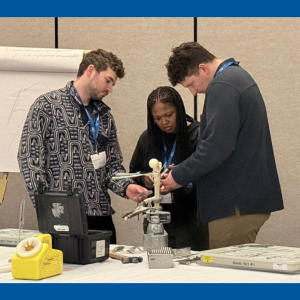
The Advanced Principles course builds on the foundational Basic Principles curriculum and emphasizes the management of complex fractures, complications, and polytrauma. Through advanced lectures, interactive case-based discussions, and hands-on surgical technique sessions using artificial bone models, participants refined their approach to challenging injuries of the upper and lower extremities, pelvis, and acetabulum. The curriculum also highlighted advanced strategies for malunions, nonunions, management of complications, and modern fixation planning.
This year’s course showcased Duke’s strong presence and engagement. Dr. Allen Champagne, MD (PGY-3), earned first place for Best Case Presentation, standing out among a competitive national cohort. His presentation demonstrated excellent clinical judgment, technical insight, and mastery of advanced fracture management principles.
Champagne attended alongside fellow PGY-3 residents Dr. Zachary Aman, MD, and Dr. Chanell Brown, MD, MPH, both of whom successfully completed the Advanced Principles curriculum. Their participation reflects Duke Orthopaedics’ dedication to developing technically skilled, academically involved trauma surgeons who contribute at the highest national levels.
Meanwhile, Duke faculty also contributed to the AO Trauma Basic Principles course, further reinforcing the department’s leadership role in orthopaedic trauma education. Faculty involvement not only shapes the next generation of surgeons but also strengthens Duke’s long-standing partnership with AO Trauma, a global leader in fracture education and innovation.
“AO courses set the benchmark for trauma education,” said DeBaun. “It was rewarding to serve as faculty and to see our residents not only participate but excel. Champagne’s achievement is well-earned, and all three residents represented Duke with distinction.”
The Department congratulates Champagne, Aman, and Brown, and thanks DeBaun and the Duke faculty for their ongoing leadership in national orthopaedic trauma education. Together, they exemplify Duke’s commitment to surgical excellence, academic engagement, and the advancement of patient care.