

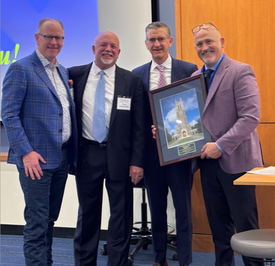
The 16th Annual Emily Berend Adult Reconstruction Symposium (EBARS), held April 10–11, opened with a powerful, purpose-driven keynote by visiting professor Brian Parsley, MD, FAAOS, of Houston Methodist Orthopedics & Sports Medicine (Medical Center). Parsley opened the meeting with Life Lessons in Medical Mission Work, sharing more than three decades of experience delivering orthopaedic care to underserved patients in developing countries—and the lasting impact those experiences have had on his practice and perspective.
“I have been participating in medical mission trips to Guatemala and Haiti for the past 33 years,” Parsley said. “It is a calling that positively changes everyone it touches.”
Parsley’s presentation set a powerful tone for the meeting, according to Michael Bolognesi, MD, professor of Orthopaedic Surgery and chief of the Adult Reconstruction Division.
“Dr. Parsley exemplifies what it means to be both an outstanding surgeon and a servant leader,” Bolognesi said. “His presentation reminded us that technical excellence and human compassion are inseparable. The lessons he shared—about creativity, humility, and purpose—resonated deeply with our faculty, trainees, and guests.”
Parsley volunteers extensively with Faith in Practice (FIP) and Operation Walk International, organizations dedicated to providing life-changing orthopaedic and medical care to patients who otherwise have no access to treatment. He vividly recalled his first mission trip to Guatemala, where 133 appointments were scheduled over four days.
“We did not see daylight for four straight days,” he said. “There was simply too much orthopedic care that needed to be provided.”
Mission work, Parsley explained, reshapes how physicians think about medicine. In these environments, surgeons encounter advanced conditions rarely seen in the United States today, including severe deformities and untreated rheumatoid arthritis.
“You see things that are no longer witnessed in the U.S.,” he noted. “It reminds you never to forget the principles of biology and the power of fixation. You have to think outside the box.”
Operating with limited supplies and imaging requires adaptability and discipline. Parsley stressed the importance of standardized protocols during mission trips, emphasizing that consistency improves outcomes and helps teams function efficiently under pressure.
“Standardize your care in this space,” he advised. “The mission team will catch on quickly. You have to hone your on-the-spot critical thinking and solutions.”
He also offered a key surgical principle that applies both abroad and at home: let the pelvis rest.
“In the U.S., we are often very cavalier and want to do everything at once,” Parsley said. “When a procedure is broad, it’s often better to do things in pieces.”
Beyond surgical technique, Parsley highlighted the profound personal impact of medical mission work. Volunteerism, he said, requires creativity, resilience, and a willingness to do whatever it takes to solve the problem—but the rewards extend far beyond the operating room.
Mission work strips away administrative burdens and reconnects physicians with their core purpose: healing patients who have no other hope. The gratitude patients express is immediate and overwhelming, offering perspective rarely found in standard practice. For Parsley, the work also represents a seamless integration of faith and vocation.
“It gets you back to the basics of health care and why most of us went into medicine in the first place,” he reflected. “The blessings I receive in return are so much more than any dollar I could ever be paid.”
FIP’s global impact underscores that message. The organization serves approximately 17,000 patients annually, fields 48 mission teams each year, and has been supported by more than 65 mission trips from Parsley alone—accounting for over 25,000 patient bed-nights at FIP guest houses.
As Parsley emphasized, FIP’s mission extends beyond medical and surgical care: to ensure every patient knows they matter, that they are valued, and that they are loved.
His message resonated throughout the EBARS audience, reinforcing the symposium’s commitment not only to surgical excellence and innovation, but also to compassion, service, and purpose at the heart of orthopaedic care.